
photo: Sarah Rogers
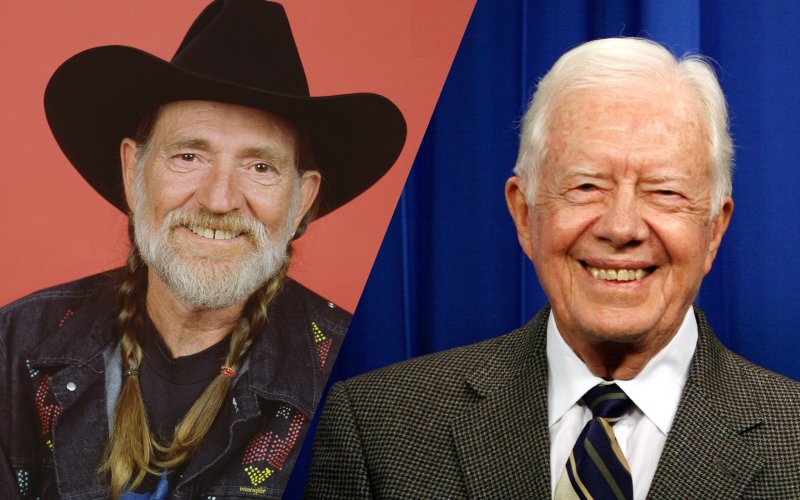
Willie Nelson and Jimmy Carter: Our Real American Heroes
www.thedailybeast.com
by: Malcolm Jones
For a couple of weeks now, I have been enjoying the easygoing and remarkably addictive pleasure of Django and Jimmy, the new album by Willie Nelson and Merle Haggard. The title cut celebrates a pair of formative influences, Django Reinhardt and Jimmie Rodgers, and I could have stood a few tracks covering the work of those artists (Willie did put Django’s “Nuages” on a recent album and frequently performs it in concert). But this isn’t really a concept album. Instead, it’s just two great musicians having fun. Or should I say, still having fun. Merle is 78. Willie is 82. They could do anything they like—including nothing at all—at this stage of their illustrious careers. But they’ve chosen to make music, writing songs and performing actively. And thank goodness for that.
At the same time, I’ve also been reading the latest Willie Nelson autobiography,It’s a Long Story: My Life (the first version, Willie, appeared in 1988), as well as the autobiography of former President Jimmy Carter, A Full Life: Reflections at Ninety.
Both Nelson and Carter have indeed led long, full lives, and both clearly believe those lives are far from over. Carter ends his book talking about spending more time on his painting and woodworking—things he can do, he says, when he slows down and can no longer build houses for Habitat for Humanity, or go skiing, or broker another peace agreement. Willie ends a little more poetically, noting that even coming home is the beginning of another journey.
(I know it looks awkward to call one man by his first name and the other by his last, but it just feels dead wrong to call Willie anything but Willie, and never mind that I don’t know him any better than you do. And calling Jimmy Carter Jimmy sounds presumptuous, if not disrespectful. So from here on it’s Willie and Carter, and consistency be damned.)
If time has slowed either of these gentlemen, it would be hard to say how. Each man is clearly up and at it every day. Upon leaving the presidency in 1981, Carter quickly founded the Carter Center in Atlanta, which was initially a forum for crisis mediation around the globe before becoming one of the foremost NGOs in the fight against diseases in the Third World. As he writes, “I was not interested in just building a museum or storing my White House records and memorabilia; I wanted a place where we could work.” He has also been a highly visible volunteer with Habitat, and written countless books on subjects including public policy, his childhood, women’s rights, and nature, as well as books of poetry and even fiction: The Hornet’s Nest, about the American Revolution, is the only novel ever written by a president, and it’s not half bad. Typically, after people asked him repeatedly if he ever just kicked back and had fun, he wrote a book about that (downhill skiing, mountain climbing, birdwatching, and fly fishing).
Hard work is a constant theme in Carter’s life, whether it be farming, political campaigning, or mediating some international dispute. The child who took shorthand in school is father to the man who undertook a speed reading course when he reached the White House. But work, in Carter’s life, is never separated from learning something new, and learning is never separated from purpose. Perhaps this comes from the way he grew up. In the Depression-era South, if you wanted food, you grew it. If you wanted furniture, you built it. Self-sufficiency was not an ideal, it was simple reality.
A Southern boy like Carter, Willie grew up in rural Texas doing his share of farm work, too. In his case, of course, music was a much bigger part of life right from the start (his grandmother, who raised him and his sister, Bobbie, was the town’s music teacher). But here again, the principle of self-sufficiency held sway: if you wanted music, you made it yourself.
The conventional wisdom denigrates Carter’s presidency and extols the man, but no one ever asks the obvious question: if a decent, hardworking, intelligent man can be great but can’t be a great president, isn’t there something wrong with the way we think about the presidency?
As for Willie, he may have led a messier life (four marriages, trouble with the IRS), but he’s the man who gave us “Crazy,” “Night Life,” and “Funny How Times Slips Away,” tunes that still remind us just how subtly artful—and how moving—good country songs can be.
At a time when genuine American heroes are hard to find, I’d say Jimmy Carter and Willie Nelson are as close as it gets and better than most. Neither man is falsely modest, but neither is full of himself. Both are still full of wonder—at the world and at what they’ve done in it. As Willie muses about his songwriting, “When songs fall from the sky … all I can do is catch them before they land. They are mysterious gifts [that] strip me bare and leave me amazed … Did I really write these songs, or am I just a channel chosen by the Holy Spirit to express these feelings?”
Men of faith, men of action, contemplative men who believe in getting things done and helping the downtrodden wherever and however they can—if I had to instruct kids coming along about where to look for heroes, I’d start with these books, which in their very different ways are like roadmaps for rich, useful lives.
And if an extraterrestrial were to approach me and ask, what does America have to show for itself, I wouldn’t hesitate. Ray Charles might be dead, I’d say, but Jimmy Carter and Willie Nelson still walk the planet. And if you think can do better than that, then let me introduce you to Dolly Parton.