
Sandler Center for the Performing Arts
Virginia Beach, FL
October 21, 2011
The title of Willie Nelson’s solo debut on Blue Note Records, American Classic, refers as much to the man himself as to the storied Tin Pan Alley repertoire he explores on this elegant new set. While it’s common now for pop artists to attempt to put their own stamp on the American Songbook, Nelson practically invented the approach. He set the standard for, well, playing the standards more than thirty years ago with Stardust perhaps this ‘outlaw’ entertainer’s most daring move, an album that many industry pundits thought would get him laughed off the charts and out of the biz.
Fans around the world know that the adventurous Nelson can sing just about anything — and with just about anyone he pleases. As he sees it, ‘The more songs you know, the more musicians you listen to, the more writers you hear, the better equipped you are to decide where you want to go next. That’s why I want to listen to everyone and everything and then decide which way I wanted to go. Then, of course, I might change my mind and go in an entirely different direction. But at least I have all of these options.’
On American Classic, he’s joined on vocals and piano by Diana Krall in an intimate rendition of “If I Had You: that feels more like pillow talk than mere wishful thinking. (“It came off so well — she’s so smooth and her piano playing is the best,” praises Nelson.) He also duets with Nora Jones, countering playful protestations with romantic persuasion on Frank Loesser’s “Baby It’s Cold Outside.” (“That particular song has a lot of meaning for me,” Nelson admits, “and it’s obvious that I enjoy singing with her.”) Backing musicians include such notable jazzmen as pianist Joe Sample, bassist Christian McBride, Krall guitarist Anthony Wilson and drummer Lewis Nash, Nelson’s longtime sidekick Mickey Raphael, his memorable co-star on Two Men with the Blues, plays harmonica, adding evocative, bluesy inflections to ‘Angel Eyes’ and ‘Since I Fell For You.”
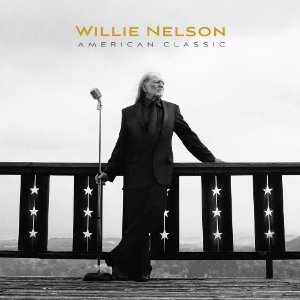
American Classic represents old-school record making at it’s most sumptuously swinging, with a lighthearted yet sophisticated jazz feel. Three time Grammy award winning producer Tommy LiPuma — known for his best-selling work with Natalie Cole, Barbra Streisand, Anita Baker, Michael Buble and Krass, among others — helmed the sessions, joined by his veteran engineer-mixer colleague, Al Schmitt. Legendary composer arranger Johny Mandel contributed orchestral charts.
The key to the project, notes LiPuma, “was that we all realized how much we loved Bob Wills and the Texas Playboys. That brought us all together. I was a big fan of Wills, as was Joe; Willie, of course, was a huge fan, as well as a huge fan of Django Reinhardt. So after we chose the songs and got the keys and all that stuff, we left a day or so to figure out what made the most sense as far as Willie was concerned, what Willie felt the most comfortable with. We ended up with a Django/Bob Wills feel to the arrangements and Willie fell right into it. ‘The Nearness of You’ was one of the first things that jumped right out, and from there we ended up dong about 16 or 17 tracks, then knocking it down to the ones we put on the album.
Nelson and LiPuma spent four days in December ’08 at Legacy Studios in Manhattan, and then reconvened in February at the storied Capital Studio A in Los Angeles, where Frank Sinatra and Nat ‘King’ Cole cut many of their best-known sides, to work with Diana Krall. Throughout the sessions Nelson’s singing retained its easygoing chrm. There’s warmth and humor in his delivery, along with some twinkling-in-the-eye sex appeal. Just check out his rendition of ‘On the Street Where You Live’ — you can feel the eternal spring in his step.
As a Nashville artist in the ’60s, Nelson himself penned more than a few tunes that have arguably become American classics themselves, including ‘Crazy,’ ‘Night Life’ and the sublime ‘Funny How Time Slips Sway.’ But that was jjust the prologue for the iconoclastic singer song-writer, who would redraw the borders of country music in the ’70s afte moving back to Texas and settling in the musical melting pot of Austin. Along with fellow traveler Waylon Jennings, Nelson was labeled the outlaw of the genre, bht he was more visionary than rebel, especially with the way he attracted rock fans to take a closer look at country. He was celebrated for his work with buddies like Waylon Jennings, Merle Haggard, Johnny Cash and Kris Kristofferson, but scaled even greater chart heights by singing, improbably enough, with Julio Iglesias (‘To All the Girls I’ve Loved Before’). Along with Marsalis, recent cohorts have included Western swing band Asleep at the Wheel and reggae icon Ziggy Marley.
Nelson ends the album with a re-interpretation of ‘You Were Always on My Mind,’ the one-time Elvis Presley hit that Nelson took to #1 on the country chart and to Top Five on the pop chart in the early eighties. Looking back for a moment, Nelson decides, ‘Hopefully, I’m a better singer. Hopefully, I’m a better guitar player — you’re either going to get better or worse; you can’t stay in one spot. I like to think that the band and I have progressed a lot and learned a lot from doing these songs. There is truth in the statement that you learn by doing, so the more you do ’em, the better you get.’
