
Throwback to 1978: Bill Ivey and Diana Johnson accepting a donation from Willie to the Country Music Hall of Fame and Museum.

Willie Nelson’s running shoes
Country Music Hall of Fame and Museum, Nashville, TN
Throwback to 1978: Bill Ivey and Diana Johnson accepting a donation from Willie to the Country Music Hall of Fame and Museum.
Willie Nelson’s running shoes
Country Music Hall of Fame and Museum, Nashville, TN
www.lbjlibrary.org
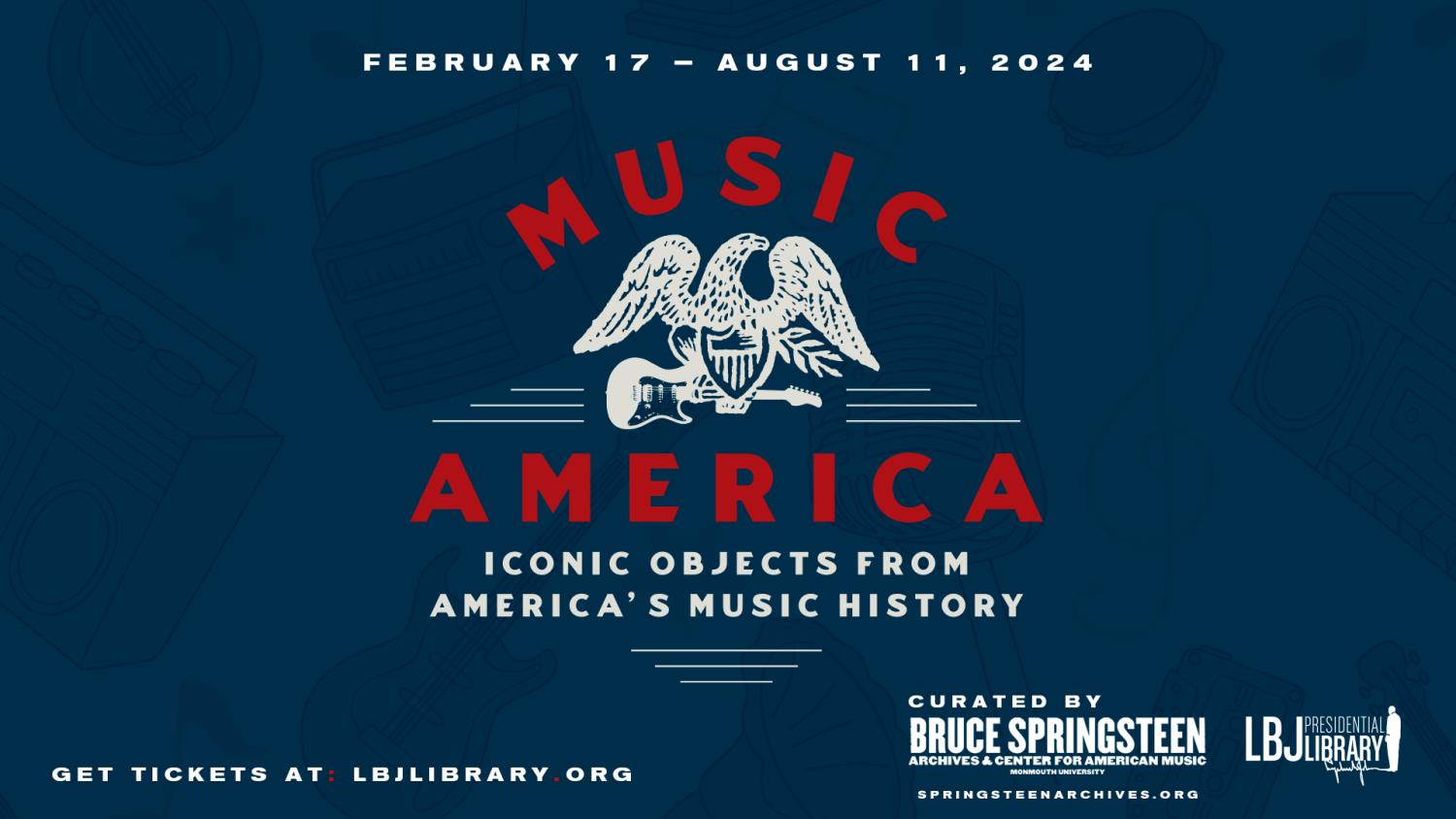
New exhibition features iconic objects and personal mementos to tell America’s music story
Exhibition dates: February 17 – August 11, 2024
(Austin, TX) – Since the nation’s inception nearly two and a half centuries ago, music has informed, interpreted, and inspired our national identity. To celebrate and explore this remarkable heritage, the LBJ Presidential Library and the Bruce Springsteen Archives & Center for American Music at Monmouth University announce the premiere of the exhibition Music America: Iconic Objects from America’s Music History. Opening at the LBJ Library on Saturday, February 17, during Presidents’ Day weekend, the exhibition will be on display through August 11, 2024.
The exhibition will feature more than one hundred objects representing the best of American music, spanning decades and genres. For the first time in one place, visitors can see everything from B.B. King’s guitar “Lucille,” the fox fur stole worn by Billie Holiday, and a handmade velvet shirt worn by Elvis Presley to Chuck D’s handwritten lyrics to “Fight the Power,” the outfit Bruce Springsteen wore on the “Born in the USA” album cover, a guitar played by Taylor Swift and a costume she wore on the Taylor Swift reputation Stadium Tour. By focusing on musicians and personal memorabilia from this country’s past and present, Music America chronicles the soundtrack of America.
Music America is curated by the Bruce Springsteen Archives & Center for American Music in association with the New Orleans Jazz Museum and Hard Rock International, along with dozens of prominent collectors of American music ephemera. “The Bruce Springsteen Archives & Center for American Music is honored to premiere Music America: Iconic Objects from America’s Music History at the LBJ Presidential Library,” said Robert Santelli, Springsteen Archives founding executive director. “Not only do we have a longstanding relationship with the library, but so much of America’s greatest music history occurred in the 1960s when President Johnson was in the White House. It seemed only natural that this exhibition, which also celebrates America’s 250th birthday in 2026, begins in Austin, one of the country’s most important music centers, and will then travel to other presidential libraries and museums across the country.”
Music lovers will enjoy an interactive “Song Bar” enabling them to hear performances by some of the artists highlighted in the exhibition, along with additional melodies that demonstrate the depth, breadth, and great productivity of American musicians.
“I hope this one-of-a-kind collection will give visitors a deeper appreciation of the role music has played in the broad sweep of American history and encourage them to reflect on the LBJ era, a period of incredible cultural and artistic change,” said LBJ Library Director Mark A. Lawrence. “These iconic objects will bring that transformation to life and transport us to another time period, as only music can.”
A partial list of artists and objects include:
Visuals: High-resolution photos of several objects are available upon request.
About the LBJ Presidential Library
The LBJ Presidential Library, located on the campus of The University of Texas at Austin, is one of 15 presidential libraries administered by the National Archives and Records Administration. Dedicated in May 1971, its mission is to preserve and protect the historical materials in its collections and make them readily accessible; to increase public awareness of the American experience through relevant exhibitions and educational programs; and to advance the LBJ Library’s standing as a center for intellectual activity and community leadership while meeting the challenges of a changing world.
The LBJ Library is open daily from 9 am – 5 pm. Last visitor admitted at 4 pm.
Willie Nelson’s running shoes
Country Music Hall of Fame and Museum, Nashville, TN

www.HistoryofWestMuseum.com
The History of West Museum, 112 East Oak in West, will feature a new exhibit, A Tribute to Bobbie and Willie Nelson, Aug. 19 through Oct. 2.
The museum is open Thursday through Saturday from 10 a.m. to 4 p.m. There is no charge for admission.
Recognizing that our past profoundly influences our future, the History of West Museum collects and preserves the history, heritage, and culture of the people of West and the surrounding area.
The exhibits reflects the 1850’s arrival of the early settlers to Bold Springs (West), the railroad, the founding fathers, farming & ranching, military veterans, and the Czech and German immigrants who brought their unique social and cultural heritage, heaving a lasting legacy to a proud city.

facebook.com/WillieNelsonMuseum
www.WillieNelsonGeneralStore.com2613 McGavock Pike
Nashville, TN(615) 885-1515
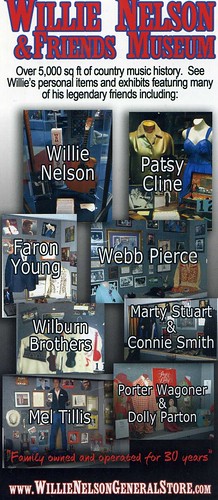
Visit the Willie Nelson & Friends Museum and General Store in Nashville, when you get the chance. It is so much fun. I got to go last March and it was just as cool as I thought it would be. My friend Jodi and I went to Nashville to see a couple Willie Nelson & Family shows and we went a couple days early to site-see. And the Willie Nelson & Friends Museum was at the top of my list, before the Country Music Hall of Fame or the Tennessee State Museum (which was my second favorite museum in Nashville).


The Willie Nelson and Friends General Store & Museum was founded July 4th, 1979 in Madison, TN with Willie’s good friends Frank and Jeanie Oakley as the storekeepers. The General Store began life as a local art & picture framing store that Willie frequented often while visiting his friends in nearby Ridgetop, Tennessee. It is the oldest, continuously operated country music artist Museum and souvenir shop in Nashville
I’ve always wanted to visit the Museum, ever since I first heard about it. And it’s not just because I love looking at collections of Willie Nelson stuff, which you know I do. But when I read about how the museum got started by close friends of Willie Nelson I knew it would have be different than lots of museums. And there are lots of museums in Nashville, but this one really does have heart. It has an unusual collection of original photographs, movie souvenirs, posters and more.
And it is a real country music museum in town. Not only it’s rare Willie Nelson collections and photos and movie props, the Museum features other country music artists, friends of Willie Nelson. The exhibits change, as well, as they get new items to display.
Their website is very entertaining and interesting, too, and they are on FaceBook.


Check out more of their great souveniers and gifts on their website:
www.WillieNelsongeneralstore.com
They have a giant souvenir and gift shop. Not just Willie Nelson merchandise, which they have a lot of, but also a huge assortment of Nashville souvenirs and T-shirts, Johnny Cash, Waylon Jennings, Jack Daniels and Elvis Presley merchandise. They have a large selection of T-shirts and toys for the kids and grandkids. The collection includes many cowboy hats, key chains, coffee mugs, shot glasses, clothing, western products, jewelry, souvenir guitars, specialty foods, snacks, drinks, belts and many, many other one-of-a-kind gift ideas.


The store is open seven days a week, and the adult admission price is only $8.00. That is really a great value, considering the collections they have — and compared to the other museums we visited. Children under 12 are free with a paid adult admission. Also, every visitor receives a detailed four page written guide that describes all the great exhibits and items you’ll see as you tour the museum. They have plenty of free parking, and are located right off the interstate and directly across the street from the Gaylord Opryland Hotel and the Grand Ole Opry House. They are 15 minutes from downtown Nashville, with easy access to hotels, shopping, restaurants. We found it very easily.
I’ve got to know Mark Hughes, who operates the Museum now with wife Kay Kennemore Hughes. Mark is so interesting to talk to and knowledgeable about Willie Nelson and the museum exhibits. Mark and Kay were out of town the week we were in Nashville, but his staff was so welcoming and helpful. And they weren’t just clerks taking money behind the counter, they were friendly and involved and described the exhibits and answered questions. We were sorry not to get to meet Mark and Kay, but we had a great time at the museum with the folks working that day.

Museum stores are always fun to visit, and their gift shop is great. I got some really cool souvenirs, too, including a Willie Nelson doll. They really have the biggest and most unusual collection of Willie Nelson stuff in Nashville, and you know I looked for those (The Country MusicHall of Fame gift show didn’t have any Willie Nelson stuff — they said they can only sell what’s on current exhibit upstairs) The Willie Nelson Museum and General Store had the best collections, at really fair prices.
The Museum and General store has a great website, with information about their exhibits and stories about Willie Nelson and his friends. They have an on-line store., if you can’t visit Nashville.

Willie Nelson, November 28, 1964
photo by Les Leverett
www.WillieNelsongeneralstore.com
“We’re very proud at the Willie Nelson Museum is to announce an exciting new Les Leverett photographic exhibit opening very soon – an historic country music photographic collection taken by long-time Grand Ole Opry photographer and Nashville resident Les Leverett.
Les Leverett’s photographs have been seen on hundreds of album covers, books, magazines, newspapers and video. Les’ photographic career at the Grand Ole Opry spanned more than 32 years. His love of the Grand Ole Opry and its many stars are evident throughout the images captured through the lens of his trusty Nikon camera.

www.wideopencountry.com
by: Lori Liebig
If you’re a country music lover, there are plenty of historic sites that come to mind when you think of Nashville: Music Row, Broadway, the Country Music Hall of Fame. Sure, those places are must-sees for tourists, but if you’re longing for a unique look into the lives of country music’s biggest legends, there’s one lesser-known museum you should visit — the Willie Nelson and Friends Museum.
Owner Mark Hughes inherited the museum from his father, Frank Hughes, who was a friend of Nelson’s. Frank and his wife once owned framing store in Madison, Tenn., which Nelson regularly visited. Over the years, they collected memorabilia from Nelson and other famous regulars, like Johnny Cash. After legions of country music fans began visiting the store for its array of unique souvenirs, the frame shop evolved into the “Willie Nelson General Store.” The store moved to various locations around town before becoming the “Willie Nelson and Friends Museum.”
Today, the bright blue building sits in a strip mall across the street from what was once known as Opryland, which is now home to the sprawling Opry Mills shopping mall. Nearby you’ll find the historic Nashville Palace music venue.
THE MUSEUM IS ONE OF THE FEW LASTING MONUMENTS TO THE OLD NASHVILLE.
Back in the early 1990s, the McGavock Pike area of East Nashville was a huge tourist destination, thanks to Opryland and its new Grand Ole Opry House, along with the large outlet malls and shops in the area. Opryland closed in 1997, and during that time there was a huge focus on reviving the downtown district. With the opening of the Bridgestone Arena, Wildhorse Saloon and rebirth of the Ryman Auditorium, there wasn’t much left to keep business in East Nashville.
Yet, somehow, the Willie Nelson and Friends Museum stayed afloat as the businesses around them went under. Although it doesn’t have the interactive touchscreen exhibits or modern design of its much newer counterparts downtown, it has a story that makes it a truly special place.

One of the big reasons why the museum is still operating, even when other businesses around it began to close, was because of their ever-expanding gift shop. Along with the novelty Nelson-themed items, you can buy souvenirs of all shapes and sizes shapes from the Music City. As downtown Nashville has blossomed, many of these types of tourist-friendly shops have closed, making theirs one of the last of its kind.
Once you get to the back of the massive store, you’re greeted by a set of saloon doors that mark the entrance to the museum. As you step through, hundreds of items that hold their own amazing stories greet you.Many of the objects found inside the museum came from an 1990 IRS auction of all the country legend’s personal items. Although the Hughes family gave most of those items back to Nelson, the rest are currently on display in the museum for fans to enjoy.

One of Nelson’s worn out pairs of running sneakers. For years, Nelson has been an avid runner and will only wear New Balance brand shoes to jog


Thanks so much to Janis Tillerson, from Texas, for sharing photos from her visit to the Texas Country Music Hall of Fame, in Carthage, Texas.


TCMHoF was initiated in 1998 to celebrate the contributions of Texans to the country music profession. The project highlights those individuals, living or dead, who are recognized nationally as outstanding in their field. The impressive structure encompasses 13,000 square feet of space for exhibits, a gift shop and a large banquet room.

The shoes

Hello Walls!


Thanks so much to Janis Tillerson, from Texas, for sharing photos from her visit to the Texas Country Music Hall of Fame, in Carthage, Texas.
TCMHoF was initiated in 1998 to celebrate the contributions of Texans to the country music profession. The project highlights those individuals, living or dead, who are recognized nationally as outstanding in their field. The impressive structure encompasses 13,000 square feet of space for exhibits, a gift shop and a large banquet room.
The shoes
Hello Walls!
Go see the Wittliff Collectionhttps://t.co/ZN04v8UJ6K
— Willie Nelson (@WillieNelson) September 7, 2019

Bandana
1993
Donated by Willie Nelson
Willie Nelson autographed his bandanna following his long delayed grandstand performance
Scheduled to play in 1981, Nelson was forced to cancel due to illness. In 1982, his show was rained out. Loyal fans were treated to a three hour plus show when Willie finally took the stage in 1983.

“Willie’s Fire,” an illustration by Sam Yeats made for the Country Music Hall of Fame and Museum’s “Outlaws
www,kosu.org
by: Jewly Hight
Few periods of country music history have received more popular attention (or rock press) than the outlaw movement. Decades later, its towering personas — Willie and Waylon chief among them — remain a subject of fascination, immortalized as leathery, long-haired stoners and speed freaks who operated entirely outside the law of the country music establishment. By the time the movement had run its course, it had become a marketing tool for the industry. These days, the “outlaw” label gets applied to all sorts of artists who are viewed, or want to be viewed, as rejecting commercialism, slickness or docility, and serves as branding for everything from a satellite radio station to a cruise and entire categories of online merch.
There’s undeniable appeal to heroic tales of musical rebellion, but the way that idiosyncratic music-makers and conservative executives interacted during that era was actually far more complicated. Tyler Mahan Coe, creator of the podcast Cocaine & Rhinestones, has made it his mission to sort reality from mythology through deep, irreverent dives into pivotal figures, sounds, songs and scandals from country music history.
He’s joking about his ignominious pedigree; he carries the family name of one of country music’s more notorious provocateurs, his dad, David Allan Coe, with whom he once toured as guitarist. But that didn’t deter museum staffers from reaching out to the younger Coe, offering access to research materials, once they heard his podcast.
The first episode went live last October. During it and every episode after, Coe beseeched his listeners to geek out about the week’s topic with a friend. Midway through the season, he lamented the podcast’s lack of mainstream media coverage. Within months, he was reeling a bit from the intensity of the buzz it was generating.
People were responding not only to the fact that he’d filled a previously vacant niche in the podcasting landscape, but that he’d found a compelling tone and approach. On one hand, he treated his subject matter with a serious-minded thoroughness that we’re more prone to expect from an experienced journalist or academic than a self-educated upstart. On the other, he had the bristly enthusiasm and brashness of someone who staked his authority on firsthand knowledge and personal investment, who relished collecting and correcting country lore. When he feels like someone’s spreading inaccuracies, he says, “I can’t let it go.”
Coe was anxious to see what the museum’s brain trust would do with an exhibit titled “Outlaws & Armadillos: Country’s Roaring ’70s,” how it would tackle prevailing notions of country outlaws and the cultural rivalry between Nashville and Austin. So he joined me for a tour guided by Peter Cooper and Michael Gray, two of the curators responsible for the ambitious project.
Coe is well aware that the role he plays in contextualizing history is far different, and more that of an outsider, than the role of the museum’s historians and curators, who shoulder responsibility for judiciously shaping, reshaping and institutionalizing the country music narrative. Its exhibits explain the folk roots of what’s become a massive commercial industry and lay out a lineage that links together stars of far-flung eras.
We convened a week and a half ahead of the grand opening. Heavy black sheets separated the area from a nearby corridor filled with browsing tourists. Here and there, post-it notes affixed to the glossy signage specified final fixes to be made to the text.
Right away Coe spotted the rusty, cylindrical shape of a moonshine still and strode toward it, asking, “What is that?”
Cooper informed him that it was the property of the singer-songwriter Tom T. Hall and the Rev. Will D Campbell, then directed our attention to other artifacts sharing the display case, including battered six-strings belonging to Shel Silverstein, who wrote country songs when he wasn’t authoring children’s books and Playboy columns, and Jack Clement, the impish producer of a staggering array of acts, that were passed around at guitar pulls and saw plenty of communal use.
Elsewhere were such rarified items as Kris Kristofferson’s military jacket, coveralls that Lubbock-bred progressive country figurehead Joe Ely wore when working for the circus, a wooden case of harmonicas belonging to longtime Willie Nelson band member Mickey Raphael, the door of the Luckenbach dancehall depicted on the cover of the Jerry Jeff Walker album Viva Terlingua and a taxidermied armadillo from the Austin nightclub Armadillo World Headquarters.
Coe has made it known in the “liner notes” to his podcast—the segments appended to each episode in which he credits his sources and explains decisions on which he expects to be challenged—that he’s wary of interviewing the musicians and business types he discusses, or people who knew them, lest he be diverted from the truth by his interviewees’ charisma, axe-grinding or desire to cast themselves or loved ones in a positive light. But assembling an exhibit of this magnitude required no small amount of outreach and diplomacy on the parts of Gray, Cooper and their colleagues.
“A lot of our job was building trust with folks in Austin,” Gray told us. “We didn’t know a lot of those folks, so we spent a couple of years just with stewardship and building those relationships, building that trust that we would tell their story correctly and [they could] trust us with their precious artifacts. Most people were eager to loan us things.”
They faced the challenge of capturing a dynamic, amorphous moment in a tangible, accessible way.
Standing in the gallery, surrounded on all sides by video footage of musical performances, Cooper and Coe were in agreement that no one sound or style defined the outlaw movement.
“You ask some people, and they’re gonna say a phaser pedal,” Coe mused, “but that’s just because they’re thinking of Waylon Jennings.”
“The whole point was to not have a sound,” Cooper concurred. “The point was to go in and get your own sound.”
A 36-track compilation album accompanying the exhibit underscores the point, placing iconic, raggedly rendered story-songs alongside eccentric string band grooves, roadhouse romps, raucous country-rockers and plaintive balladry.
The exhibit leans on the trajectory of a portion of Nelson’s career for a loose sense of chronology, beginning with a clip of him singing in his clean-cut Nashville days, passing by a fanciful painting of him flying away to Texas the night his Tennessee hog farm burned down and bits and pieces of his thoroughly casual ’70s stage attire and arriving at the jazz and pop standards he decided to record after nearly a decade’s worth of folk-country-sounding concept albums.
“You could talk about Willie growing out his hair and wearing tennis shoes and a bandana and all that in the ’70s,” Gray noted, “but showing what he looked like in the ’60s, in his suit and his [neatly combed] hair, kind of shows the transition.”
More than anything, the exhibit seeks to capture a sense of momentum and exchange, of the scene-building done at guitar pulls, parties, recording sessions, shows and festivals. Some of the music-makers depicted in it made decisive migrations, Nelson back to Texas and Mickey Newbury, Guy Clark, Townes Van Zandt and Rodney Crowell from the Lone Star State to Nashville. But many didn’t necessarily feel the need to camp out in one territory or the other. Austin, and its surrounding area, had a robust live scene encompassing hippie kids and rednecks, while Nashville had the studio facilities, industry infrastructure and pro songwriters.
Coe had caught glimpses of several mentions of his own father by the time we were finished perusing for the day, but he had other reasons to be satisfied with what he’d seen and heard. He and I sat down together in a tiny, glassed-walled conference room of a building housing shared work space after perusing the “Outlaws & Armadillos” exhibit. Grazing on grocery counter sushi, he declared, I feel like the approach taken there is the approach that I would take to doing something like this. Which is, ‘I’m gonna have to say some things that some people think are the opposite of the truth.’ But it’s more important to history that the real story gets told than it is that someone’s feelings don’t get hurt because they’ve had it wrong in their own way of thinking about it.”
This interview has been edited for length and clarity.
What popular narratives about outlaw country were you mindful of going into the exhibit?
I see a lot of people who have this idea of, “It was all guns and drugs and people getting shot and all this craziness.” OK yeah, but not any more so than the entire history of country music. This has always been that culture. It’s just there was a little window of time there where the image sort of embraced that aspect of these outsider personalities, and even inflated it.
You’ve pointed out in the podcast that the lasting significance of particular moments, movements and artists emerges over time. And so does mythology.
The scope of my interest in the podcast ends at the year 2000, and it’s because we don’t have any idea what’s going on now until it’s all over. You’ve got a bunch of people running their mouths right now, acting like they know what they’re talking about. And then in 15 years, and in 50 years, we’re gonna find out how much they don’t know what they’re talking about.
I think one of the biggest misconceptions people have is that there was some great animosity between everyone working in Nashville and everyone working in Texas — or just outside of Nashville. And that’s not really the case, because for one thing, the Nashville industry was built by people, many of whom were worshipped by the artists working in the outlaw movement. Bobby Bare was as establishment as it gets. Willie Nelson himself was as establishment as it gets.
You don’t get much more establishment than [Nelson and Waylon Jennings’ manager] Neil Reshen coming to Nashville to lay down the law for his artists. That’s the establishment fighting the establishment on behalf of the artists. Anyone who’s seen behind the curtain of the music business knows that’s what happens every single day is the establishment fighting the establishment on behalf of their vested interest. That’s something I think is there for everyone who would like to read in the exhibit, at least in a subtle way.
Since there really isn’t a uniform stylistic stamp on the music, I looked for the connecting threads and timeline as I walked through.
I was really happy that they used [the album] Wanted: The Outlaws as sort of like, “OK, this is about over by the time it gets to this point.” The common perception is probably that that album began the outlaw movement. That has been my experience in speaking with country music fans for my entire life. They wear that t-shirt of that album cover and talk about how great the outlaw country movement was. I’m certainly not disparaging this in any way. I’m not trying to, like, myth-bust this. It was great music that they were making, but the reason why the exhibit sort of tapers off there is ’cause the artists wanted to taper it off there. They were like, “This is getting out of hand.”
You can’t spell it out more directly than Waylon’s song.
It shouldn’t be read as criticizing it, or somehow saying that it was fake, therefore not good. The artists saw it had run its course.
What forces do you see converging in the outlaw moment? How much did it matter that some country artists were developing high-concept visions for their albums or placing more value on the work of narrative-driven singer-songwriters? Or cultivating rougher stage looks?
I think there really are a lot of factors. The conversation that I was most excited to be having, even though it didn’t really get to a solid answer, was when we were talking to [curator] Michael [Gray] about [record man] Shelby Singleton’s role in sort of anticipating this whole vibe, the zeitgeist of this. I don’t see how you could argue that [Singleton] didn’t see this coming when he signs David Allan Coe and puts out an album called Penitentiary Blues in 1970. But there was something that let people know that this was about to be the thing that happened. There was something in Nashville that people could see gathering. And it really is ephemeral. It’s sort of like an attitude, like a feeling in the air or something.
When you get Willie going down to Texas, he’s not really involved in the album-making machine, and he’s making something happen in places like the Armadillo World Headquarters. He’s got this thing happening and people are responding to that. They’re not showing up because they heard this on an album and they want to see if he can play it live. They’re just showing up to see what’s happening in the room right now.
So then it flips and it becomes a question of, “How do I get what’s happening in this room onto an album so everyone who wasn’t in this room can experience it?” And that’s when you run into a problem coming back to Nashville, trying to explain to a guy wearing a suit behind a desk, who’s never been to the Armadillo World Headquarters, “No, dude, if we make it sound like this, people will buy it.” That’s the real shift that happened, was paying attention to what was happening everywhere else. That’s the problem that comes with being Nashville, Music City: “We know how this is done. We know everything there is to know about this.” And I think that’s really what we’re looking at here, is this sort of [acknowledgement]: “Maybe we don’t know everything. Maybe we should let these people play around a little.”
It wasn’t a complete withdrawal from the music-making system so much as a reckoning within it.
It really did happen from within the system. And the system was smart enough to play the role of the bad guy, if needed. The president of a record label doesn’t care if Waylon Jennings’ fans think he’s a cool guy or not: “Waylon, if you’re gonna sell albums, we’re good.” It’s more of a collaborative effort than I think people realize.
I appreciate the fact that you regularly place artists in conversation with the cultural landscape, market factors and industry realities in the podcast. It’s simpler to avoid all of that context and spin narratives of artistic heroism.
I think it’s an extremely naïve perspective to take on it, to assume that an artist doesn’t care if they’re moving units or not. Of course they care, because if they don’t move units, they don’t get to do this anymore. If you just want to play guitar on your front porch, no one’s stopping you from doing that. As soon as you come and get into this game, it’s art and commerce.
Some of the other exhibits that have been staged in that space featured the perspectives of industry execs and producers a little more prominently. Those aren’t the voices narrating this story.
I don’t know if you noticed, but right when you came out of the exhibit they made a big deal about the photo of Waylon being right there. Right behind it was the Billy Sherrill [section of a separate exhibit].
Billy Sherrill is someone I love talking about in relationship to the outlaw era, because he’s generally seen as the anti-outlaw. He’s generally painted as one of the bad guys in the story of how [Nelson’s album] Red Headed Stranger came to be released. He’s supposed to be one of the guys who hated it and said that it sounded like a demo. I don’t doubt at all that he said that, because if you go back and listen to that album with the ears of a producer of that time in Nashville in country music, that s*** sounds like a demo. It sounded that way on purpose. It wasn’t like Willie doesn’t know how to make an album. Willie made the album he wanted to make, and history proved him correct.
But also Billy Sherrill produced Johnny Paycheck. You can’t say that that didn’t happen. So Billy Sherrill is as much a part of the outlaw movement as Jack Clement. [Note: Like Sherrill, Clement bridged several different eras and styles of production in Nashville. In the mid-’70s, he produced Dreaming My Dreams for Waylon Jennings.] If you want to say that Jack Clement was a part of the outlaw movement, you have to say that Billy Sherrill was too. Also all the David Allen Coe albums that everyone loves holding up as a picture of such a crazy traditionalist move, [much of that] was produced by Billy Sherrill.
Did you expect to see more on your dad in the exhibit? Didn’t they say that they tried to get one if his rhinestone suits?
They tried. It’s difficult. My father has filed bankruptcy, so you lose a lot of stuff. He has defaulted on payments for storage units and lost who knows what. Money has been a problem for him. He’s not a very responsible person, you know?
I felt like there was an appropriate amount of David Allan Coe in the exhibit if your gauge of it is fame. He’s certainly not as famous as Waylon or Willie. He’s probably approximate to Guy Clark or Jerry Jeff Walker. It’s hard to talk about fame quotients. I don’t really know if I’m right about that or not.
They have the promo footage of “Penitentiary Blues,” which I think is indicative of their awareness. That’s not a country album. It’s electric blues. It was released on an R&B label, not on a country label, and it wasn’t trying to be country. It was made in Nashville and the whole story was, “Here’s a new white blues singer who has been in and out of prisons his entire life.” There’s no way that doesn’t go into the ingredient list for outlaw country. That’s in the exhibit, and I think it should be.
A lot of the artifacts underscored how this wild-eyed, freewheeling socializing and music-making music coexisted.
What’s funny is what you just described is very much my perception of country music in Nashville from the beginning. If you read about Tree Publishing, particularly the time when Don Gant was in there taking care of business, doing very well at his job in a commercial sense, you go in there after hours and he’s gonna have 25 people in his office. They’re going to be smoking pot and they’re going to be listening to the initial pressing of an album that somebody’s been working with or they’re going to be passing a guitar around and just hanging out. It’s a party, but out of that party comes hit records. That’s really always been my understanding of how at least the songwriter and publishing world in Nashville [worked].
Was there anything that struck you as being especially new about the museum’s take on this era?
Honestly, the entire exhibit itself you could think of as new, in that it is what we think of as the country music establishment recognizing what we think of as the country music anti-establishment. I am not aware of the museum really featuring outlaw country to this extent before. I’ve only been back in Nashville for five years, so I’m not super aware of what they’ve been doing [before that].
And placing ’70s Nashville and Austin side by side, that’s new.
If a picture [in the exhibit] was taken in Nashville, it was someone from Texas, or if it was taken in Texas, there was someone from Nashville in the picture, so the lines really are blurry.
There’s that entire panel of artifacts from Texas figures like Doug Sahm, Jerry Jeff Walker and Joe Ely.
Doug Sahm is also someone that I don’t think a lot of people — not necessarily country music nerds, but music nerds who picture him with Sir Douglas Quintet, I think his inclusion might come as a surprise to people. But that’s also kind of funny because they have the [western stage] suit that he wore as a little kid. I mean, no one could have predicted the outlaw country movement when he was getting started. [Note: Sahm was a pedal steel prodigy and performed alongside Hank Williams. Sr.]
Right next to his stuff was a small Freda and the Firedogs display. I think it’s significant that a band that released zero recordings but impacted Austin’s live scene is included.
This is something that I think can get lost in a lot of conversations like this. We have a general tendency to talk about albums as if they are the only thing that matters. And all that an album is is just a fraction of what was going on at the time.
But this exhibit is focused very little on the actual music. It’s so much more about the culture that was happening around it.
The scene.
Willie Nelson’s picnic and the fact that it was country music that they were putting in the center of this conversation, and it’s drawing all these other types of people. To me, that is the outlaw country era really more than the albums. It’s the culture shift around it.
The Fourth of July picnic is a lasting institution. It’s still happening every year and still seems to represent more or less the same cultural mash-up. That’s the one place where the exhibit nods to an ongoing lineage, mentioning artists like Jason Isbell and Eric Church playing it in recent years.
There’s a great story [that I’ve heard] about George Jones playing one of the early picnics. George was just sweating bullets the whole day because he’s looking at all these people walking around with their shirts off, long beards, long hair, topless women, people smoking pot openly. He’s in a rhinestone suit and his band is in matching rhinestone suits, and he’s like, “These people are gonna tear me apart. I’m gonna get up there and people are gonna think I’m a dork.” And he gets on stage and pretty much everyone agrees that he was the hit of the whole day, that he was everyone’s favorite act.
It’s remarkable that rednecks and hippies were inhabiting the same live music spaces, the same scenes. Willie Nelson succeeded in making himself all things to all people, and that’s still the way he’s written and talked about.
Willie Nelson was the main focal point of the outlaw movement, and the outlaw movement reached out its hands to every other music community and said, “You can come hang out here.” That’s how you end up with Willie Nelson as one of the most recognizable figures in country music history. It’s because of the vibe of freedom, that these are people who are doing it their own way.

photo: Peter Blackstock/American-Statesman
The entrance to the new Outlaws & Armadillos exhibit, which opened May 25 at the Country Music Hall of Fame and Museum in Nashville and will run through early 2021.
At left is a portrait of a young Willie Nelson painted by Austin artist Kerry Awn.
Read article, see more photos here.

www.CountryMusicHallofFame.org
Willie Nelson. Waylon Jennings. Kris Kristofferson. Jessi Colter. Bobby Bare. Jerry Jeff Walker. David Allan Coe. Cowboy Jack Clement. Tom T. Hall. Billy Joe Shaver. Guy Clark. Townes Van Zandt. Tompall Glaser. Today, all names synonymous with the word “outlaw,” but 40 years ago they started a musical revolution by creating music and a culture that shook the status quo on Music Row and cemented their place in country music history and beyond.
The Country Music Hall of Fame® and Museum’s upcoming major exhibition, Outlaws & Armadillos: Country’s Roaring ’70s, will explore this era of cultural and artistic exchange between Nashville, Tenn., and Austin, Texas, revealing untold stories and never-seen artifacts. The exhibition, which opens May 25 for a nearly three-year run, will explore the complicated, surprising relationship between the two cities.
While the smooth Nashville Sound of the late 1950s and ’60s was commercially successful, some artists, such as Nelson and Jennings, found the Music Row recording model creatively stifling. By the early 1970s, those artists could envision a music industry in which they would write, sing and produce their own music. At the same time, Austin was gaining national attention as a thriving music center with a countercultural outlook. Musicians of varying stripes migrated to Austin, where the disparate strains of country, bluegrass, folk, blues, rock, and conjunto blended to create a unique environment hosted by music–friendly venues such as the Armadillo World Headquarters, Broken Spoke, Soap Creek Saloon and Antone’s.
“Outlaws & Armadillos: Country’s Roaring ’70s offers an unprecedented look at some of the most compelling music and artists in music history,” said museum CEO Kyle Young. “This was an era in which renegades Bobby Bare, Waylon Jennings and Willie Nelson fought for and won creative control of their own songs and sounds. It was a time when melodic poets Guy Clark, Townes Van Zandt and Billy Joe Shaver elevated public perception of what a country song could be. It was a time when the Austin, Texas, music and arts scenes blossomed, and when characters like singer-songwriter Jerry Jeff Walker, Hondo Crouch (who bought his own town, Luckenbach, Texas), armadillo art specialist Jim Franklin and University of Texas football coach Darrell Royal changed Lone Star culture. At the time, some of these things seemed unusual, even insane. Now, they all seem essential to any understanding of this great American art form, country music.”
Read more here.
