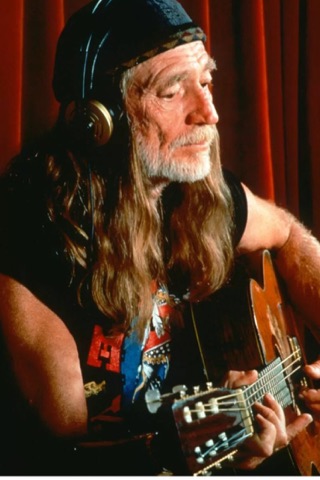
Thanks, Phil Weisman, for sharing this great classic photo.
Day 2 of our @williesreserve takeover!!! ????
Check out our website for details on our fresh drops, and new stuff!?
?by @MonicaALewin LEIRA Digital Design#willienelson #williesreserve #relaxwegotyou #botanico #saturday #shotgunwillie pic.twitter.com/UPA3ZFFd5B— Botanico (@BotanicoMMJ) March 23, 2019
Spotlight Pictures is set to release Lian Lunson’s much awaited film, Waiting for the Miracle to Come, to international markets. Starring Willie Nelson, Charlotte Rampling, and Sophie Lowe, Waiting for the Miracle to Come a gorgeous, evocative, and meditative film about faith, love, and fulfillment in spite of loss.
Set in a magical and timeless world reminiscent of an old photograph, Waiting for the Miracle to Come is the story of how Adeline Winter (Lowe), a trapeze artist grieving the death of her father embarks on a journey to find “the Beautiful Place” in Ransom, California. The Beautiful Place Museum, owned and run by Dixie and Jimmy Riggs (Rampling and Nelson). The Riggs have waited for decades at The Beautiful Place, hoping that the daughter they gave up for adoption would come looking for them. Both Nelson and Rampling capture the heartache of loss and the daring of hope while Lowe’s quietly powerful performance pulls viewers along on her pilgrimage.
Waiting for the Miracle to Come was written by Lian Lunson, especially for Willie Nelson. Her long time mentor, Filmmaker Wim Wenders, is an executive producer on the film.
Waiting for the Miracle to Come is about connections—what they mean, what they feel like,” Lunson says. “It is styled in otherworldliness to bring the supernatural element closer.” Audiences will find themselves transported into this dreamlike world, discovering “gold” in hidden places throughout.
The film features an original song performed by Willie Nelson and written by Bono, who is also an executive producer. Waiting for the Miracle to Come is available for purchase on DVD and digital platforms internationally through Spotlight Pictures.

Three lucky winners will be the first to receive our beautiful Collectors’ Edition Blueray DVD. To enter to win, sign up for our email list below! The winners will be announced on Willie’s Birthday, April 29th.

www.johnsoncitypress.com
By: Zach Vance
BRISTOL — It was only fitting that famed filmmaker Ken Burns and PBS chose the Birthplace of Country Music Museum on Sunday for their first stop of a 30-city national tour to promote “COUNTRY MUSIC,” a new eight-part, 16-hour film detailing the history of the American musical genre.
After all, Bristol is where, in the summer of 1927, record producer Ralph Peer of the Victor Talking Machine Company recorded the “Bristol Sessions,” featuring the first recordings of Jimmie Rodgers and the Carter Family, that launched what became known as the “Big Bang” of modern country music.

Several dozen people filled a small theater inside the museum to watch the roughly 10-minute introduction to the film, and once it concluded, the crowd chanted “more, more, more.”
A larger screening of the film was held later Sunday at the Paramount Center for the Arts, but the full 16-hour film will premiere at 8 p.m.on PBS, beginning Sept. 15-18 and continuing Sept. 22-25.
Burns was joined by the film’s lead writer Dayton Duncan, co-producer Julie Dunfey and Old Crowe Medicine Show founding member Ketch Secor, who is featured in the film, for a panel discussion following the screening of the introduction.
“Obviously, the ‘Bristol Sessions’ are ground zero … for the story sort of coming together and the creation and coalescing of country music,” Burns told the audience.
“The Bristol story that we try to tell may not be as in depth as you all know it, but I think it will help put this on a much larger map and put it in context. The thing that struck us in the many, many years we’ve been working on it is that country music is not just one thing, but many many different kinds of things.”
As one interviewee points out during the introduction, country music offers something for everyone, no matter their mood, whether it’s heartbreak, redemption, success or love.
“At the heart of every great country music song is a story,” Burns said.
“As the songwriter Harlan Howard said, ‘It’s three chords and the truth.’ The common experiences and human emotions speak to each of us about love and loss, about hard times and the chance of redemption. As an art form, country music is also forever revisiting its history, sharing and updating old classics and celebrating its roots, which are, in many ways, foundational to our country itself.”
The film project has been in the works for around eight years. Dunfey said several researchers were sent across the country to gather archival footage and photographs.
In total, she said 100,000 old photos were collected, with 30,000 of those were were scanned into a database and just 3,300 making it into the final product. Roughly 700 hours of archival footage was gathered and whittled down to 2 hours and 37 minutes for the audience to see.
Dunfey said the crew received hours of home video from Johnny Cash’s four daughters, including footage of Cash with Elvis Presley. Never-before-seen photos and footage of Rodgers, among others, will also be showcased in the film.
The documentary boasts an incredible lineup of country music stars, including Dolly Parton, Vince Gill, Reba McEntire, Merle Haggard and Willie Nelson. Of the more than 100 people interviewed for the documentary, 40 are members of the Country Music Hall of Fame.
Including Haggard, who Dunfey teases as being one of the best interviews in the film, 17 of the Country Music of Hall of Famers have since died, making the documentary that much more alluring.
Birthplace of Country Music Executive Director Leah Ross credited the museum’s senior adviser, Keith Liskey, for sparking the museum’s involvement in the film.
“As soon as (Liskey) heard that Ken Burns was going to do a documentary on country music, he said, ‘We’ve got to get in touch with him,’” Ross told the crowd prior to the screening.
“So we called Florentine Films and we’ve been working with them for almost five years, a little over five years on this documentary, and we’re honored to have been able to contribute to the story.”
This film will be Burns’ 32nd documentary, dating back to his first in 1981 “Brooklyn Bridge” that details some aspect or history of America. In addition to “Country Music,” Burns is working on five others: “East Lake Meadows,” “Ernest Hemingway,” “Ali,” “The Holocaust & The United States” and “LBJ & The Great Society.”
The promotional bus tour will continue with stops in Cookeville, Knoxville, Memphis and Nashville, with a special concert on March at the Ryman Auditorium featuring Dierks Bentley and Ricky Skaggs, among many others. A companion book written by Duncan will be released on Sept. 10. To watch the trailer for “COUNTRY MUSIC,” visit www.pbs.org/kenburns/country-music/.

BRIARCLIFF, Texas – A world away from the stage, and with the steering wheel of his old pickup truck instead of a guitar in hand, Willie Nelson loves few things more than to go on a drive around his 700-acre chunk of the Texas Hill Country near here.
He calls his ranch “Luck” and smiles as he explains, “When you’re here, you’re in Luck, and when you’re not, you’re out of Luck.”
Officials: 100 undocumented immigrants bused to SA from overcrowded facilities ‘From nothing to something’: Once homeless man moves in to tiny home Uber driver who was shot was working to save money for daughter’s…
Over 70 horses roam Nelson’s ranch, most of which he rescued before they could be sent to slaughterhouses.
“My horses are probably the luckiest horses in the world,” Nelson said. “They get hand-fed twice a day, and they were just ready to go to slaughter is probably the last thing they remembered, so they’re happy horses.”
Nelson has included his love for horses in a CD that will be released in early summer. It’s a song entitled “Ride Me Back Home.”
As he approaches his 87th birthday, Nelson is still touring and spending about 200 days on the road.
“It’s a lot of traveling and being away from home,” Nelson said. “But that’s what we do.”
With the exception of a benefit performance in 2018 for then-senatorial candidate Beto O’Rourke, Nelson’s shows are void of politics.
“We leave all of that at home,” Nelson explained. “I think that’s why a lot of people show up, because they don’t have to worry about what they’ve been watching on TV all day.”
Though in good health and living a relatively stress-free life, Nelson noted that it hasn’t always been that way, as reflected in troubles he had with the IRS.
Nelson said, “I remember that I remember those guys.” He’s since settled his debt and moved on.
“You’re supposed to get a little smarter as we get older,” Nelson said with a smile. “Every now and then, I think I’m getting a little smarter, but I’m not sure.”
Among the things he remains focused on are advocating for the legalization of marijuana, marketing his brand of marijuana, called “Willie’s Reserve,” where it’s legal and raising money for American farmers during his annual Farm Aid Concerts.
Retirement, Nelson says, is not a part of the conversation.
“I retire after every show,” Nelson said. “I say, ‘That’s it, I’m not goin’ no more,’ but then we hang out awhile and people (his band) feel like playing, and so we go play again.”

by: Matt Schudel
In 1985, Mona Lee Brock and her husband lost their farm in Oklahoma. A combination of factors — low prices for cattle and grain, high interest rates on loans, falling land values — led to the most serious financial crisis in rural America since the Great Depression.
At one point in the 1980s, the country was losing more than 2,000 family farms a week, from California to Minnesota to the Carolinas. Loans that kept farmers afloat were foreclosed, costing them their land, their livelihood and their way of life.
In many cases, farmers were uprooted from land that generations of their forefathers had tilled. They looked on as their livestock and farm equipment were auctioned off.
Mrs. Brock and her husband, F.M. Brock, held meetings of farmers, bankers and business leaders at their farm in Lincoln County, Okla., for mutual support. In the end, however, the Brocks were not able to hold on to their land, where they had raised cattle and grown wheat, soybeans and cotton. Within a year, F.M. Brock died of a heart attack.
And, where they had raised cattle and grown wheat, soybeans and cotton. Within a year, F.M. Brock died of a heart attack.
One unforeseen consequence of what became known as the “farm crisis” was that farmers began to take their own lives at a shocking rate. Mrs. Brock began to volunteer for the Oklahoma Conference of Churches, which operated a hotline for emergency counseling and suicide prevention. (It was later managed by other organizations.)
A longtime teacher and school principal, Mrs. Brock offered a sympathetic ear and a soothing, understanding presence to people who raised food to feed the world but could not afford to feed their own families. In some of the calls, she could hear despondent farmers putting shells into shotguns as they talked.

Mona Lee Brock is credited with keeping hundreds of farms from being liquidated and with saving an untold number of lives. (Farm Aid Inc.)
During her three decades as an advocate on behalf of farmers, Mrs. Brock spoke to tens of thousands of farmers, taking calls day and night. She was credited with keeping hundreds of farms from being liquidated and with saving an untold number of lives.
Singer Willie Nelson — a founder of Farm Aid, which provides assistance to struggling small farmers — called her “the angel on the other end of the line.”
Mrs. Brock was 87 when she died March 19 at her home in Durant, Okla. She had congestive heart failure, said her son Ron Brock.

by Pete Oppel
Dallas Daily News
Sept. 17, 1978
South Lake Tahoe, Nev. — The baby grand Steinway piano in Willie Nelson’s hotel suite is flanked by a window overlooking Nevada and a flight of stairs leading to a bedroom overlooking California.
Nelson, dressed in blue jeans, a blue T-shirt and blue tennis shoes is conferring with an officious looking gentleman in a conservative blue suit. Everything else in the room with the exception of the piano and six huge pillows in various shades of red, maroon and orange is geige or crystal — the sofa, the fireplace, the chairs, the thick carpet, the magazine rack, even the bar and the stereo system. Nelson’s conference is interrupted by a woman’s voice from the kitchen-dining area, located in the loft of the split-level suite.
“Dinner is served, Mr. Nelson,” the voice says.
Willie Nelson, the one-time door-to-door book salesman from Abbott, Texas, who has played every gin joint from Key West to the Puget Sound, has come a long way from the days of knocking about in Nashville and playing on the back of flatbed trucks for the opening of a Ford dealership in some one-horse town. Nelson is in the middle of a 2-week engagement at the luxurious Harrah’s Hotel in Lake Tahoe, an engagement interrupted for ao one-night only performance at the White House.
Nelson rushes through his meal (one of the few times he rushes through anything) and walks back down into the living room. He strolls around to the couch and sits. He looks at the luxury that surrounds him and remembers those earlier days, shows in such unlavish places as Panther Hall in Fort Worth, or the Sportatorium in Dallas, where Nelson returns Wednesday night — exactly one week after his White House gig — for a show with Delbert McClintock and Ray Wylie Hubbard.
“Harrah’s, Panther Hall, the Sportatorium, they’re all beer joints,” Nelson said, “apolstrey’s just a little bit better in some.”
People flocked to Harrah’s from all over the western United States to see Willie. The once-maligned (by Nashville recording executives) singer is the toast of the town, the undisputed king of country music. His infamous picnics made him a king in Texas, his recording of ‘Blue Eyes Crying in the Rain,” made him a god in national country music circles. Willie Nelson has reached the stage where he can take a non-country song like ‘Blue Eyes’ and convert it to a number one country single. He is be sought as a major motion picture star and has three movies in the works, “The Songwriter,” a movie based on his album, “Red Headed Stranger,” and the ultimate measure of success, a project with the working title of, “The Willie Nelson Story.”
And what has nelson done to generate all this recent acclaim? What has he done differently to change the way the country music establishment regards him during the past couple of years?
The answer is absolutely nothing.
“Our music is good and I think it took people a long time for anyone to hear it,” Nelson says. “And the people who hears it, they like it, and they want to come see a show. I haven’t changed. I’m doing basically the same thing I’ve been doing all along.”
Willie was one of the first of the breedof country singers labeled “progressive country.” There is really nothing progressive about Nelson’s style. In fact, if anything, Nelson’s music is rooted in the simplistic patterns of Hank Williams, Kitty Wells and Roy Acuff.
“I’ve never really left the old style,” he says. “The term progressive country was applied to the appearance of the people who were playing the music and it really didn’t really have anything to do with the music itself. When a guy had long hair, he played progessive country. If he had short hair he played AM Top 40 Country.”
The strange thing about the Willie Nelson success story is that it was the young people — the crowd with the musical diet of the Jefferson Airplane, the Doors, Big Brother and the Holding Company — that first tuned into Willie Nelson and responded to his songs.
“The music has always been something that they always would have liked, had they been associated with it,” Nelson said, “They just didn’t have any place to go and listen to it. Then they found out they could go to the Armadillo (an Austin club) and hear good country music. They’d been hungry for it all along. They’d been hearing their parents play it while they were playing rock and roll, creating a separation there — there was a barrier between rock and roll and country for a long time because the parents liked country and the kids liked rock and roll. So somewhere along the way there had to be an agreement of some kind. And the kids made the concession, if there was a concession to be made, because they were listening to the same kind of music their parents were listening to. I don’t know if they realized they were conceeding anything or not.”
Willie Nelson performs two shows a night at Harrah’s. The audience at the 8:15 dinner show consist of the well-heeled, because Harrah’s Showcase is the place to be at Lake Tahoe. The second show, which begins at midnight, draws the hard-core Nelson fanatics. They whistle. They stomp. They cheer. They shout. They won’t let Willie leave the stage, forcing him back for seven encores. And Willie gives them a show they will not soon forget. The songs are the same, but Willie and the band play them with abandon. An instrumental jam on Whiskey River (a song he sings three times for an estatic second-show audience) sounds more like the Allman Brother’s Band than hard-line country music. But this is Willie Nelson.
His version of “Georgia on My Mind” in these late night shows has an ending that redefines the term ‘country soul.’ His treatment of ‘Amazing Grace’ is pure enough to reform the gamblers who are tossing silver dollars into slot machines, onto crap tables, around roulette wheels and in the general direction of the black jack dealers not more than a couple hundred feet from the stage where Willie Nelson is singing.
“Even so more in a place like this (a gambling casino), that song is enjoyed because it is so different than what they are hearing around them,” Nelson says. And they can get in to a song like ‘Amazing Grace’ and ‘Will the Circle be Unbroken’ beecause they don’t expect to find it here.
“But most of the people here can afford to be here. There’s nobody here that’s throwing away their rent money, I don’t think.”
Hopefully, the excitement of a Willie Nelson performance in this atmosphere will be captured on his next album.
“My next release is a live album,” Nelson says. “The last time I was here I cut a live album. The new album will be coming out in October.” The album, a two-record set, will contain all of the familiar Nelson songs plus his version of Rodney Crowel’s ‘Til I Gain Control Again’, which he has recently included in his shows. It will not incude any new Nelson compositions.
“I’ve got some new songs, ‘She’s Gone’, ‘Angel Flying Too Close to the Sun’, and ‘Is the Better Part Over’? I want to get enough for a new album. I want to have a whole album of new songs.
Nelson says the picnics — those July 4th happenings that were either a musical extravaganza or Bataan with all the fun taken out of it, depending on your point of view — are not history. “The status of the picnics is the same as it is every year after the picnic, I guess,” he says. “No one knows what’s going to happen next year.”
The 1978 picnic came during the Texxas World Music Festival at the Cotton Bowl.
“The accommodations were great, the stage was fine, the sound was good, the shows were good, but I don’t think the atmosphere was a Fourth of July Picnic atmosphere,” Nelson says. “It would have been a lot more uncomfortable out there in a pasture, somewhere, but personally I would have liked that more. The Cotton Bowl would be a good place to do a show, in a cooler time of year. And for the Fourth of July it would be better to have it outside where you have a breeze, a lake you can go swimming. And I think people enjoy the fact that they are not that well controlled. Everything is too easy in the Cotton Bowl. I mean, you can go get a snow cone, a drink of water, or go to the bathroom. That’ s not a picnic. They’re supposed to be rougher than that.
Willie Nelson is 45 years old and to many people around the country, who learned about Willie through “Blue Eyes’, an overnight success, “a real Cinderella story,” Willie says with a laugh. Not only has he seen it all, he has played in every place he’s seen. Now Willie has just about done it all. He has gone from the very bottom to the very top. Is there any reason to go any longer? Has he every thought about getting out the rat race he’s sentenced himself to?
“The thought comes up very often,” he says. “But, I enjoy playing. If I didn’t go out and play with my band on the road, I’d be out in some other joint somewhere with just me and my guitar with a bunch of guys I don’t even know, because I like to play. And as long as I have my health and can travel around and do it, I’m going to do it. And I’ll quit when I get tired of playing music.”
[Thanks again so much to Christine Majors (and her mother) for saving these clippings about Willie Nelson from the ’70’s, and sharing them with me, to share with you. I admire anyone who can hold on to newspaper clippings for over 30 years. I love reading these old interviews and articles.]


